You have invested in Google Ads and Local SEO. You finally have a steady stream of traffic coming to your website from potential customers in Vadodara and Indore.
But your phone isn’t ringing.
Why? It might be because your website is failing Google’s Core Web Vitals test.
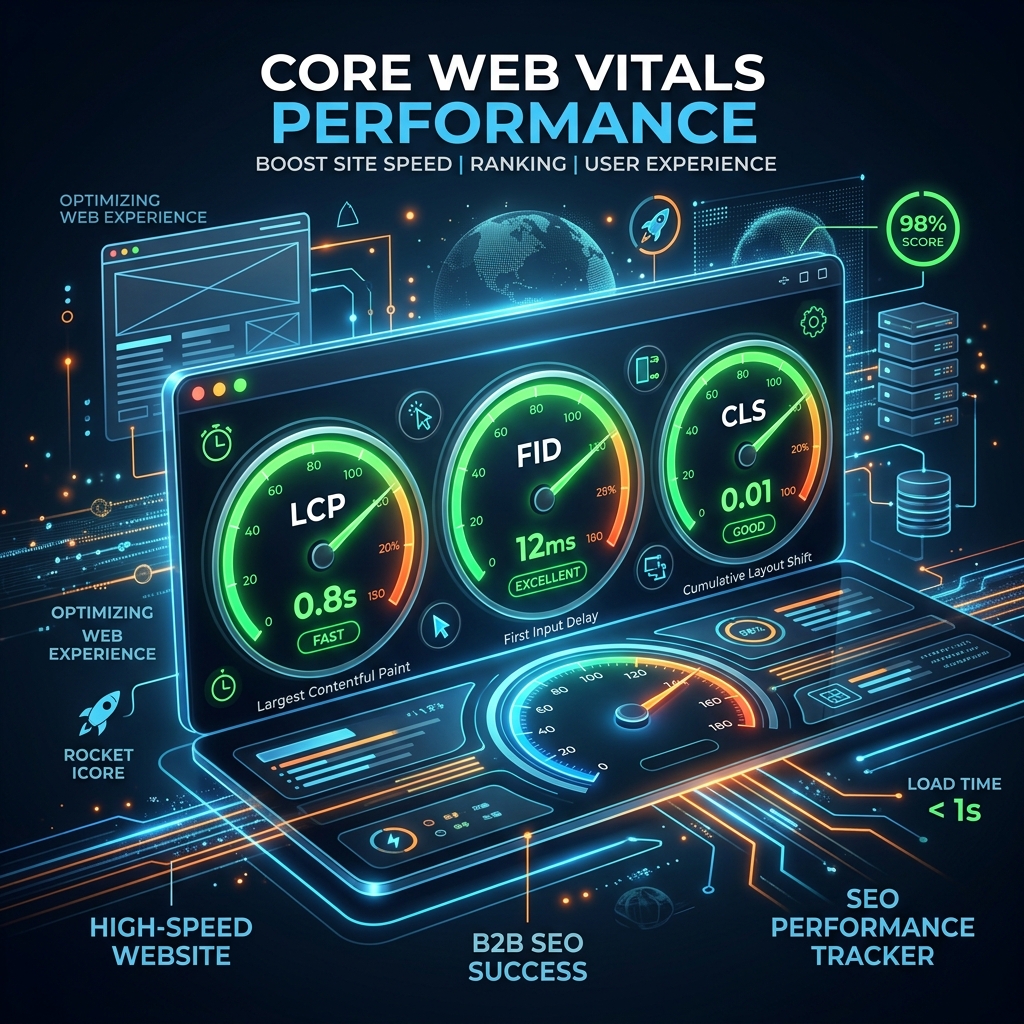
In simple terms, Core Web Vitals are a set of specific factors that Google considers critical for an excellent user experience. They measure how fast your page loads, how quickly it becomes interactive, and how visually stable it is while loading.
If your website is slow or jumpy, Google will penalize your rankings, and human users will simply leave. Here is a plain-English breakdown of what Core Web Vitals are and why they matter to your bottom line.
1. Largest Contentful Paint (LCP): The “Loading Speed” Metric
What it means: LCP measures how long it takes for the largest piece of content (usually a hero image, a video, or a large block of text) to become fully visible on the screen.
The Benchmark: Google wants your LCP to be under 2.5 seconds.
Why it matters to your business: Imagine a factory manager in Makarpura searching for industrial suppliers on their phone. If your website takes 5 seconds to load the hero banner, that manager assumes your website is broken and hits the back button. That is a lost lead. A fast LCP proves to the user that your site is reliable and open for business.
How to fix it:
- Compress large images using modern formats like WebP.
- Use a fast web hosting service (preferably with servers in India).
- Remove unnecessary, bloated WordPress plugins.
2. Interaction to Next Paint (INP): The “Responsiveness” Metric
Note: INP replaced First Input Delay (FID) in 2024.
What it means: INP measures how quickly your website responds when a user interacts with it (like clicking a button, opening a menu, or typing in a contact form).
The Benchmark: Google wants your INP to be under 200 milliseconds.
Why it matters to your business: Have you ever tapped the “Submit” button on a contact form and… nothing happened for a few seconds? You probably tapped it three more times in frustration. High INP causes users to rage-click or abandon your site because it feels unresponsive or broken. If you want people in Indore to seamlessly book a consultation, your buttons need to react instantly.
How to fix it:
- Minimize complex JavaScript execution on the main thread.
- Break up long-running tasks in your code.
- Ensure your mobile menu is lightweight and CSS-driven rather than relying heavily on JavaScript.
3. Cumulative Layout Shift (CLS): The “Visual Stability” Metric
What it means: CLS measures how much the elements on your page shift around while the page is loading.
The Benchmark: Google wants your CLS score to be under 0.1.
Why it matters to your business: You are reading a paragraph about a service, and suddenly an ad or an image loads at the top of the page, pushing the text down. Worse, you go to tap a link, the layout shifts, and you accidentally tap a different button.
This is incredibly frustrating for mobile users. A high CLS destroys trust. A stable layout ensures that when a potential client goes to click your WhatsApp link, it stays exactly where it should be.
How to fix it:
- Always include width and height attributes on your images and videos.
- Never dynamically insert content above existing content.
- Use system fonts or preload web fonts to prevent “flashes of unstyled text” (FOUT).
Does Website Speed Still Matter for SEO?
Absolutely. But it is no longer just a “tiebreaker.”
Since the rollout of the Page Experience update, Core Web Vitals are a direct ranking factor for both mobile and desktop searches. If two local SEO agencies in Vadodara have equally good content and backlinks, the one with the faster, more stable website will rank higher in the map pack and organic results.
Furthermore, speed directly impacts your conversion rate. Amazon famously found that every 100ms of latency cost them 1% in sales. For a local B2B service, a 2-second delay could cut your lead generation in half.
Conclusion
Core Web Vitals are not just arbitrary numbers for developers to chase. They are direct indicators of how easily a customer can interact with your business online.
If your website was built five years ago on a heavy template, there is a very high chance you are failing these metrics today. At Global Prospect Media Solution, we build ultra-fast, modern websites using Astro and React that consistently score 95+ on Google PageSpeed Insights.
Stop losing leads to a slow website. Request a free website performance audit from our team today.